Recovery Is Measurable: Biomarkers That Put Training Stress and Recovery in Context
Learn how HRV, resting heart rate, sleep, performance, subjective readiness and blood biomarkers can provide context for training stress and recovery.
Published September 23, 2026
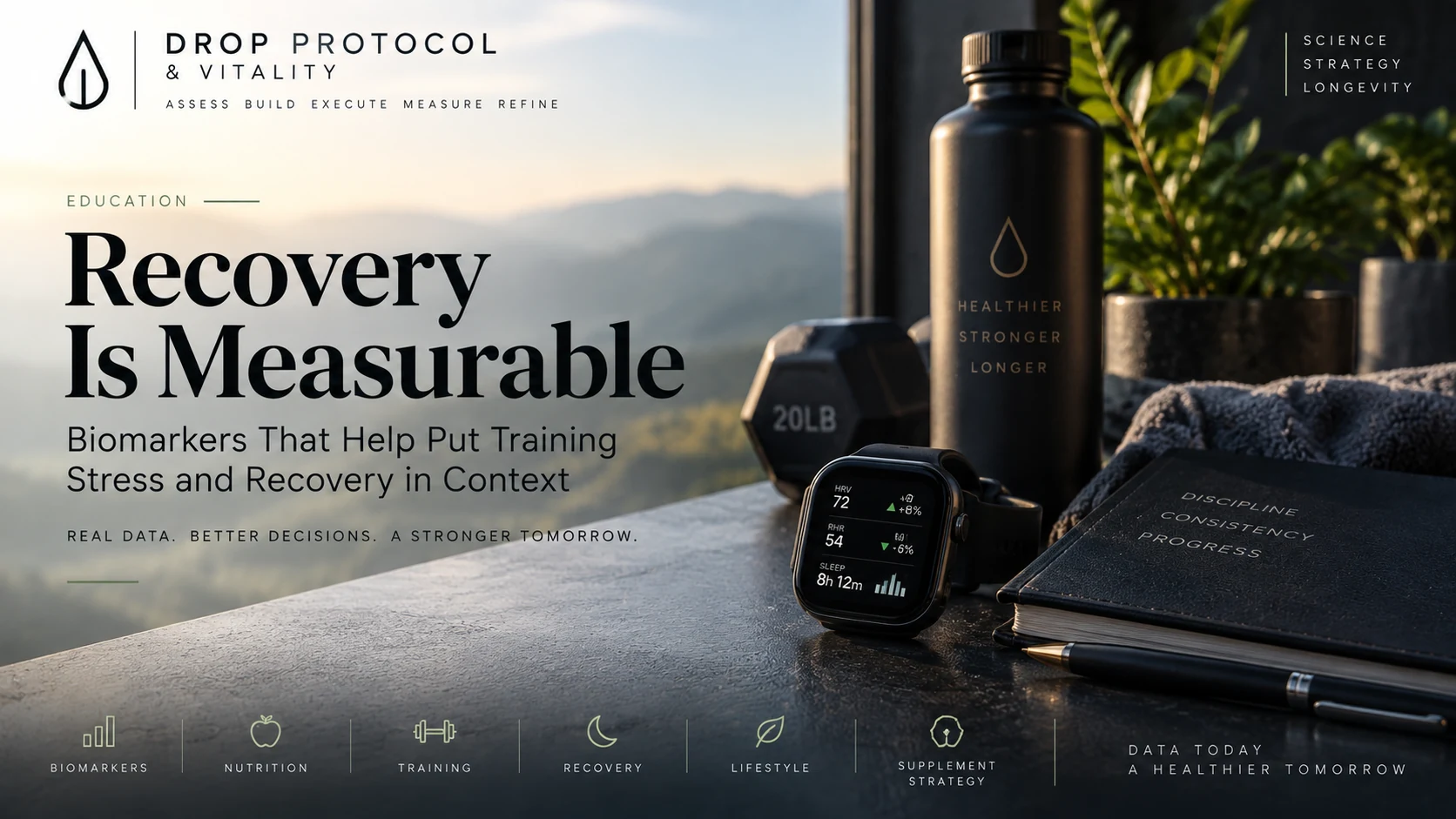
Recovery is often described as a feeling: fresh or fatigued, ready or sore, motivated or flat.
Those observations matter. But they are only part of the picture.
Resting heart rate, heart rate variability, sleep, training performance, perceived exertion and laboratory biomarkers can provide additional information about how someone is responding to training and other stressors.
None of them is a standalone recovery test.
That distinction matters.
Training creates stress by design. Adaptation depends on applying enough stress to stimulate change while allowing enough recovery for that stress to be resolved. The useful question is not whether stress exists. It is whether the pattern of stress, recovery and performance is moving in the intended direction.
That relationship between training demand and adaptation also connects to our overview of mitochondrial health and cellular energy.
The strongest picture usually comes from combining measurements rather than asking one number to explain everything.
Recovery is a pattern, not a score
Modern wearables make recovery look remarkably precise.
A watch or ring can turn heart rate, HRV, sleep and activity into a single number before breakfast. That number may be useful as a summary, but the precision of the score can exceed the precision of the underlying measurements.
Recovery itself is multidimensional.
Training load matters. So do sleep, nutrition, illness, psychological stress, travel, hydration, environmental conditions and an individual's normal physiological variation.
Research on sport recovery reflects this complexity. Consensus literature emphasizes the balance between stress and recovery while recognizing substantial differences both between people and within the same person over time.
That makes longitudinal context more useful than treating a single morning measurement as a verdict.
A recovery score can be one input.
It should not become the entire decision.
Resting heart rate: simple, useful and easy to misread
Resting heart rate is one of the easiest physiological measurements to track.
When measured under reasonably consistent conditions, changes from an established baseline can provide context about cardiovascular and autonomic state.
The key word is context.
Resting heart rate can shift for reasons that have little to do with training adaptation. Sleep loss, illness, dehydration, heat, stimulants, alcohol, emotional stress and measurement conditions can all influence the number.
A reading of 62 beats per minute is therefore not inherently "good" or "bad."
For someone whose typical morning resting heart rate is 61 to 64, it may be completely ordinary.
For someone whose established baseline is consistently much lower, a sustained change could deserve attention, especially if it appears alongside poor sleep, unusual fatigue or declining training performance.
The value is in the deviation from the person's own pattern.
HRV adds another view of autonomic state
Heart rate variability describes variation in the time interval between consecutive heartbeats.
It is not simply a measurement of how fast the heart is beating.
Common HRV measurements, including RMSSD, are used in sport and exercise research as noninvasive indicators related to autonomic nervous system activity.
That has made HRV popular for monitoring training adaptation and recovery.
There is legitimate evidence behind that use, but HRV is easy to overinterpret.
Measurement conditions matter. Time of day, posture, breathing, recording duration, device methodology, recent exercise and other stressors can affect the result.
Individual baselines also vary considerably.
This is why a single HRV value has limited meaning without a comparison point.
The more useful question is whether HRV is behaving normally for that individual under standardized conditions and how the trend relates to training, sleep, perceived recovery and performance.
Research on HRV-guided endurance training suggests that HRV can contribute to training decisions, but it does not support treating HRV as a universal readiness switch.
The trend provides information.
It does not make the decision by itself.
Sleep belongs near the center of recovery
Sleep affects far more than whether someone feels tired the next morning.
It intersects with physical performance, cognition, immune function and the ability to tolerate training demands.
Athlete sleep research also makes clear that sleep requirements are not identical for everyone. Training schedules, competition, travel, stress and individual sleep needs all influence the picture.
That makes two kinds of information particularly useful:
- how much and how consistently someone is sleeping,
- and how that pattern relates to how the person feels and performs.
Consumer wearables have made sleep tracking easy, but the numbers require perspective.
Studies comparing wrist-worn consumer devices with polysomnography, the laboratory reference method for sleep assessment, have found meaningful differences in measurements such as total sleep time, sleep efficiency, latency and wake after sleep onset.
Wearables can still be useful for observing patterns across many nights.
They should not be treated as if they are performing a clinical sleep study on the wrist.
This distinction becomes especially important with sleep-stage estimates. A device may display exact minutes of deep or REM sleep, but the apparent precision should not be mistaken for laboratory-equivalent measurement.
For everyday monitoring, consistency often matters more than obsessing over whether a device labeled a particular 20-minute period as one sleep stage or another.
Training performance is itself a measurement
Wearable data can become so prominent that an obvious signal gets overlooked: performance.
What happened during training?
A useful monitoring system should preserve that question.
Depending on the activity, performance indicators might include:
- load and repetitions at a given effort,
- running or cycling output,
- pace at a comparable heart rate,
- jump performance,
- repeated-effort capacity,
- session duration,
- or perceived exertion at a familiar workload.
A persistent mismatch between expected and actual performance can add important context to other recovery signals.
The opposite is also true.
A wearable may produce an unfavorable morning score while training performance remains normal, perceived effort is appropriate and the broader trend is stable.
Neither signal should automatically cancel the other.
They are different observations of the same system.
Subjective recovery is data too
Fatigue, soreness, mood, motivation and perceived readiness are sometimes dismissed because they are subjective.
Research does not support dismissing them so easily.
A systematic review comparing subjective and objective athlete-monitoring measures found that self-reported measures were often sensitive to changes in acute and chronic training load. Subjective and objective measurements also did not necessarily move together.
That is useful information rather than a reason to choose one side.
Someone can report unusual fatigue before a wearable produces a dramatic change.
An objective measurement can also shift before the person notices anything subjectively different.
A practical monitoring system can use both.
Simple questions asked consistently can be informative:
- How recovered do you feel?
- How sore are you?
- How was your sleep?
- How motivated are you to train?
- How difficult did a familiar session feel?
The answers become more useful when recorded over time rather than reconstructed from memory after performance has already changed.
Blood biomarkers can add context, but there is no single recovery panel
Laboratory testing can provide another layer of information.
Depending on the individual and the reason for testing, biomarkers can help characterize areas such as hematologic status, iron availability, metabolic health, endocrine function, inflammation-related signals and nutritional status.
That does not mean there is a blood test for "recovery."
Research on training-load and recovery biomarkers repeatedly encounters the same problem: biological measurements are affected by timing, exercise exposure, individual variation, pre-analytical conditions and the person's established baseline.
Some biomarkers can change after demanding exercise without indicating pathology.
Others may be influenced by factors unrelated to training.
And no single accepted biomarker can diagnose overtraining syndrome.
The European College of Sport Science and American College of Sports Medicine consensus on overtraining describes the diagnosis as difficult and dependent on clinical outcome and exclusion of other potential causes. Hormonal, biochemical, immune, performance and psychological markers have all been studied, but no single marker satisfies every requirement for a generally accepted diagnostic test.
That is an important restraint.
Laboratory data can improve context.
It should not be forced into conclusions the measurement cannot support.
For a broader look at laboratory data in the context of metabolic health, read Metabolic Health: The Biomarkers That Tell the Bigger Story.
Trends usually matter more than isolated readings
Suppose resting heart rate rises one morning.
That observation alone has many possible explanations.
Now suppose it remains elevated relative to baseline for several days while HRV moves outside its usual range, sleep duration falls, perceived fatigue increases and familiar training sessions begin to feel unusually difficult.
The interpretation changes because the pattern changed.
This does not create a diagnosis.
It creates better context.
Longitudinal monitoring works because each person gradually establishes a reference against which future observations can be compared.
The useful baseline is often personal.
Population reference ranges still matter for many clinical laboratory measurements, but performance monitoring frequently gains additional value from knowing what is normal for the individual.
That is one reason consistency in measurement is so important.
If morning HRV is collected lying down one day, standing after coffee the next and after training on another day, part of the apparent "trend" may simply be measurement noise.
Better data begins with repeatable conditions.
Measurement quality matters as much as measurement quantity
More data does not automatically create more understanding.
A dashboard containing resting heart rate, HRV, sleep stages, body temperature, blood biomarkers, glucose, training load and a composite readiness score can still produce poor decisions if nobody asks what each measurement actually represents.
Every useful measurement has a scope.
HRV does not directly measure muscle recovery.
Resting heart rate does not directly measure sleep quality.
A wearable sleep-stage estimate is not polysomnography.
A blood biomarker is not a complete description of training readiness.
A laboratory result for a research material likewise has meaning only in relation to the analytical method used and the question that method can answer.
The same principle applies across very different forms of measurement:
- know what was measured,
- know how it was measured,
- and know what the result can reasonably establish.
For readers interested in analytical measurement in laboratory research materials, Vial Drop Labs explains why peptide purity and quantitative content per vial are separate analytical measurements.
The same measurement principle is also relevant to the distinction between pathway biology and outcomes discussed in our article on NAD+ and cellular energy.
Human biomarkers and research-material analytics answer different questions
The previous comparison should not be taken to mean that human biomarkers and laboratory-material assays are interchangeable.
They are not.
The connection is methodological.
A human biomarker may provide information about a physiological system under defined conditions.
An analytical test performed on a research material may provide information about identity, purity, quantity or another material characteristic under a defined method.
In both cases, interpretation becomes unreliable when a measurement is asked to answer a question outside its scope.
This is why analytical documentation matters.
Readers interested in how laboratory research materials are characterized can review the analytical standards used to interpret research-material documentation maintained by Vial Drop Labs.
A better recovery dashboard
A useful recovery dashboard does not need dozens of measurements.
It needs measurements that answer different questions.
A practical framework might include four layers.
1. Training exposure
What work was actually performed?
Record the variables that matter for the activity: volume, intensity, duration, load, pace, distance or another relevant measure.
2. Physiological response
How is the body responding?
Resting heart rate and consistently collected HRV can provide useful longitudinal signals. Laboratory biomarkers may add context when there is a specific reason to measure them.
3. Recovery behavior
What happened between training sessions?
Sleep duration and consistency, nutrition, hydration and other lifestyle factors influence the environment in which adaptation occurs.
4. Performance and perception
How is the person functioning?
Training performance, perceived exertion, fatigue, soreness, mood and motivation provide information that a sensor cannot fully replace.
The goal is not to make every signal agree every morning.
The goal is to recognize meaningful patterns.
From measurement to decisions
Data collection is easy to expand.
Decision quality is harder to improve.
The value of recovery monitoring comes from deciding what to do with the information.
Sometimes the appropriate response to an unusual reading is simply to collect another day of data.
Sometimes several signals moving together justify examining training load, sleep, nutrition, illness, life stress or another variable more closely.
Persistent or concerning symptoms belong in an appropriate clinical evaluation rather than being explained away by a wearable score.
Drop Protocol & Vitality uses a simple sequence:
ASSESS → BUILD → EXECUTE → MEASURE → REFINE
Recovery monitoring fits naturally into that framework.
Assessment establishes context and baseline information.
A plan defines the intended training and recovery inputs.
Execution creates real-world data.
Measurement shows how the individual is responding.
Refinement uses that information to adjust the plan.
The process repeats because physiology is not static.
The objective is context, not perfect prediction
There is no single number that completely describes recovery.
That is not a failure of measurement.
It is a reflection of biology.
Resting heart rate can provide one signal. HRV can provide another. Sleep patterns, training performance, subjective readiness and laboratory biomarkers can each add information.
The strongest interpretation comes from understanding the limitations of each measurement and looking for patterns across time.
Recovery becomes more measurable when the question changes from:
"What is my recovery score?"
to:
"What is the evidence showing me about how I am responding?"
That is a more useful question because it leaves room for physiology, performance and context to agree, disagree and change.
Frequently Asked Questions
What are the best biomarkers for measuring recovery?
There is no single best recovery biomarker. Resting heart rate, HRV, sleep, training performance, subjective well-being and selected laboratory biomarkers can each provide different information. Their value generally increases when measurements are collected consistently and interpreted as trends rather than isolated readings.
Is HRV a reliable measure of recovery?
HRV can provide useful information about autonomic activity and training adaptation when it is measured consistently and interpreted against an individual's baseline. It should not be treated as a standalone measurement of total-body recovery or as a diagnostic test.
Does a low HRV mean I should skip training?
Not necessarily. A single HRV reading can be influenced by measurement conditions and numerous physiological or behavioral factors. Training decisions are better informed by the broader pattern, including the person's normal HRV range, recent training, sleep, perceived recovery and performance.
Can a smartwatch accurately measure sleep?
Consumer wearables can provide useful estimates and longitudinal sleep patterns, but they are not equivalent to laboratory polysomnography. Research has identified differences between wearable estimates and polysomnography for several sleep measurements, particularly detailed sleep-stage classification.
Can blood tests show whether someone is recovered?
Blood biomarkers can add information about specific physiological systems, but there is no single blood test that establishes overall recovery. Exercise, measurement timing, individual variation and other factors can influence results.
Is there a biomarker for overtraining syndrome?
No single generally accepted biomarker diagnoses overtraining syndrome. Consensus literature describes it as a complex condition requiring consideration of prolonged performance changes and exclusion of other potential causes. Multiple physiological, psychological and biochemical markers have been studied.
Should recovery data be compared with population averages or personal baselines?
Both can have roles, depending on the measurement. Clinical laboratory results often require appropriate reference intervals and professional interpretation. For day-to-day performance metrics such as resting heart rate and HRV, an individual's longitudinal baseline can provide valuable additional context.
References and Further Reading
- Kellmann M, Bertollo M, Bosquet L, et al. Recovery and Performance in Sport: Consensus Statement. International Journal of Sports Physiology and Performance. 2018;13(2):240-245.
- Meeusen R, Duclos M, Foster C, et al. Prevention, diagnosis, and treatment of the overtraining syndrome: joint consensus statement of the European College of Sport Science and the American College of Sports Medicine. Medicine & Science in Sports & Exercise. 2013;45(1):186-205.
- Saw AE, Main LC, Gastin PB. Monitoring the athlete training response: subjective self-reported measures trump commonly used objective measures: a systematic review. British Journal of Sports Medicine. 2016;50(5):281-291.
- Walsh NP, Halson SL, Sargent C, et al. Sleep and the athlete: narrative review and 2021 expert consensus recommendations. British Journal of Sports Medicine. 2021;55(7):356-368.
- Lee YJ, Lee JY, Cho JH, Kang YJ, Choi JH. Performance of consumer wrist-worn sleep tracking devices compared to polysomnography: a meta-analysis. Journal of Clinical Sleep Medicine. 2025;21(3):573-582.
- Düking P, Zinner C, Trabelsi K, et al. Monitoring and adapting endurance training on the basis of heart rate variability monitored by wearable technologies: a systematic review with meta-analysis. Journal of Science and Medicine in Sport. 2021;24(11):1180-1192.
- Haller N, Behringer M, Reichel T, et al. Blood-Based Biomarkers for Managing Workload in Athletes: Considerations and Recommendations for Evidence-Based Use of Established Biomarkers. Sports Medicine. 2023;53(7):1315-1333.
Understand Your Biomarkers in Context
A laboratory report contains numbers. The value comes from understanding how those numbers relate to one another, to your baseline and to the outcome you are trying to improve. Drop Protocol & Vitality's biomarker assessment process is designed to evaluate relevant markers together, establish a baseline and use follow-up measurements to assess change across nutrition, training, recovery, lifestyle and supplement strategy.
Explore the Biomarker Assessment & Personalized Protocol